The IMO’s decision to postpone the adoption of the Net-Zero Framework increases regulatory uncertainty and could prompt broader regional measures such as an expansion of FuelEU Maritime.
Net-Zero Framework adoption postponed: what next?
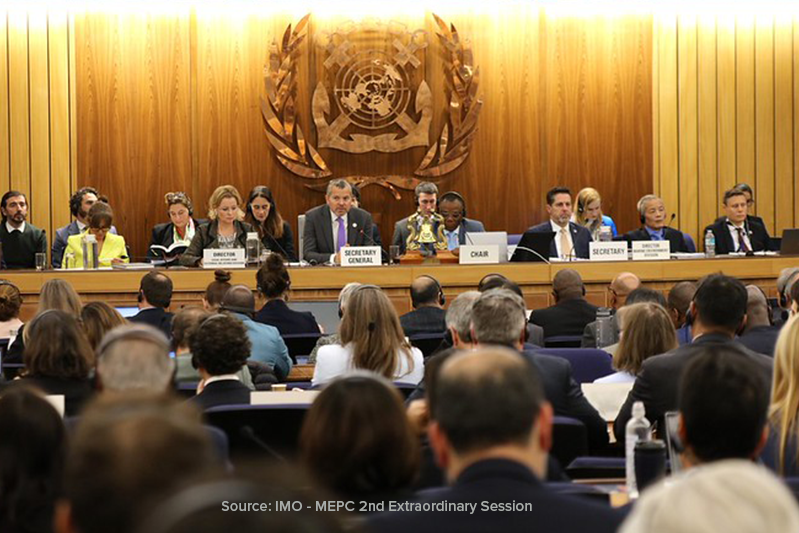


The IMO’s decision to postpone the adoption of the Net-Zero Framework increases regulatory uncertainty and could prompt broader regional measures such as an expansion of FuelEU Maritime.
For international ship operators, their investors and global trade, regulatory certainty is what really matters. Seasoned maritime watchers will remember the difficulties when the US Coast Guard introduced its own national ballast water standards a few years ahead of the International Maritime Organization (IMO). Not recognising IMO type approvals for ballast water management systems as equivalent to their own meant huge headaches for owners: from delayed installations, double certifications, technical complexity for crews and risk of detention at US ports through to market distortions as some ships avoided US ports entirely to defer costly retrofits.
Last week’s adjournment to the process of implementing a global carbon price through the IMO means that there is now an increased possibility of overlapping regulations, which would bring greater complexity and increased operating costs. The existing challenges of complying with current regional rules and regulations could seem simple in comparison to a world made-up of competing compliance regimes.
No one wants to manage multiple emissions trading schemes or be required to comply with different fuel intensity standards. But that may just be the future for ship operators.
Whether or not the delay at the IMO was really just that, a one-year delay, or a screeching U-turn remains to be seen. But for many regional governments, action on climate change is non-negotiable. If after years of debate, the 176 member states which make up the IMO are still unable to reach a broad consensus on a strategy to reduce greenhouse gas emissions, then the regions may well double down on their efforts to build emissions trading systems, set greenhouse intensity limits as well as bring in at berth regulations for shore power and create green shipping corridors. 49 countries, including most European Union (EU) members, the UK, Brazil, Australia, Canada and Pacific islands nations opposed the delays. What moves will these countries now make?
What happens next is unclear, but the IMO’s delay will likely shape future European environmental policies. The IMO’s trajectory on the reduction of the carbon intensity of marine fuels is notably more ambitious than the EU’s. FuelEU Maritime targets a 2% reduction by 2029, whilst the NZF set a 4% goal for 2028, rising to 30% by 2035. But in the absence of, or at best a delay to NZF, the EU will be under pressure to tighten its carbon intensity limits faster than planned. Here the issue of sustainable fuel certification plays a critical role. Claims of sustainability standards need to be verified and internationally recognised. Green marine fuels, including biofuels, methanol, ammonia and hydrogen, need to be certified. But at global level there is still work to be done to define what a sustainable fuel is and the certification methodologies.
But the bigger diplomatic question is whether or not the EU has the appetite to build a coalition of willing nation states through a series of multi-lateral agreements. Could the EU, Japan, Canada, Australia, the UK and Singapore harmonise their rules to build a bottom-up pathway to net-zero maritime emissions in the absence of IMO consensus? Will regions bordering the EU be pressurised to comply with its regional standards? Maybe financial or technical assistance will be on the table to support partner countries in Africa and Asia to align with FuelEU Maritime?
Other policy levers might include a re-examination of green fuel subsidies and port infrastructure to de-risk early adoption. Port access restrictions could be introduced and the penalty regime revised. Earlier derogation of EU Outermost Regions for intra-EU trade could be considered.
The EU does have form in building global recognition of its rules.
Take the EU’s General Data Protection Regulation (GDPR) which came into force in 2018. Despite there being no United Nations or World Trade Organization global agreement on data protection and fierce opposition from the US, GDPR has shaped global regulations.
For many non-EU countries including Brazil, Japan and South Korea GDPR became the de-facto standard. Despite the US bitterly opposing GDPR as an egregious example of extraterritorial overreach, GDPR remains in place. A set of strong, enforceable rules with extranational reach were created with the EU’s huge economic weight brought to bear on global players who were forced to comply voluntarily or lose access to the EU market.
Will EU legislators take a leaf from the GDPR playbook and attempt to make FuelEU Maritime a standard widely used around the world? And will the US respond with a combination of further diplomatic objections, trade related retaliation, industry led non-compliance and legal challenges? It is exactly what has been happening for the past decade as the EU and US grapple strategic divergence on privacy issues.
The next 12 months will prove challenging. Perhaps the coming year will see refinements to the NZF which are acceptable. Working groups at the Marine Environment Protection Committee (MEPC) will examine key parameters such as levy rates, revenue allocation and implementation logistics. Discussions will doubtlessly focus on the administration of the fund to which the proposed levies would be paid. Writing recently in the Wall Street Journal, the US Secretary of State Marco Rubio described the NZF as “a carbon tax on shipping whose revenue would be paid directly into a UN-controlled fund,” adding that “This misguided initiative was a classic case of taxation without representation, a European-driven overreach that threatened US consumers, businesses and global trade.” Can this ideological gap ever be bridged?
But whatever happens, the critical question of green fuel availability is still a long way from being solved. As a sector shipping will compete with other industries for the same limited pool of renewable energy. According to the IMO the shipping industry consumed roughly 211m tons of fuel oil in 2023, but not even 1m tons of alternative fuels (excluding LNG) in the same year. Estimates for future production vary significantly, but according to the DNV Maritime Forecast to 2050, global production of carbon-neutral fuels is projected to be between 70-100m tons of oil equivalent in 2030. Even with hugely improved bunkering infrastructure at ports, increased volumes of bio-MGO, green methanol, ammonia and e-diesel, shipping will still be competing with trucks, planes and energy intensive industries such as steel and cement for green power.
Where does this leave the shipowner and investor? Without an agreed global regulatory regime or a clear timetable, making accurate calculations on green investment payback times become extremely challenging. The typical investment horizon of a vessel is typically 20 years with significant lead times.
Today, more than ever before, shipping actors need to partner with shipbrokers who can combine market intelligence with regulatory foresight. At IG we work with clients to interpret evolving regulations and translate them into commercial strategies. From scenario planning tied to regulatory timelines to compliance mapping through to managing carbon trading strategies, IG has a dedicated sustainability team which works closely with our chartering, S&P and finance divisions to bridge the gap, partnering with a leading carbon markets advisor and environmental specialist, ClearBlue Markets.
There are no easy answers, but an industry which has successfully transitioned from coal to oil at the turn of the 20th century, restructured its governance through flags of convenience in the post WWII era, moved to containerisation in the 1970s and survived the economic shocks of the 2008 financial crisis will surely find creative solutions to abate its emissions whilst ensuring continued profitable success and enabling global trade.